
Between us monsters
Absorbing Riva Lehrer’s memoir, “Golem Girl”

I am currently down with a pretty nasty cold, while simultaneously trying to finish a grant application for the next round of CreativiTEA for Grown-ups workshops. Because, of course, I would be trying to power through a grant application while feeling like death warmed over. 🙄
In any case, I thought I’d pull an article from the archive this week to send to all of you. It’s about the amazing disabled portrait artist, Riva Lehrer and was originally posted in February 2023 when I was deep in the research for my exhibit, “The Extraordinary, Ordinary Nature of Interabled Love.”
Enjoy!
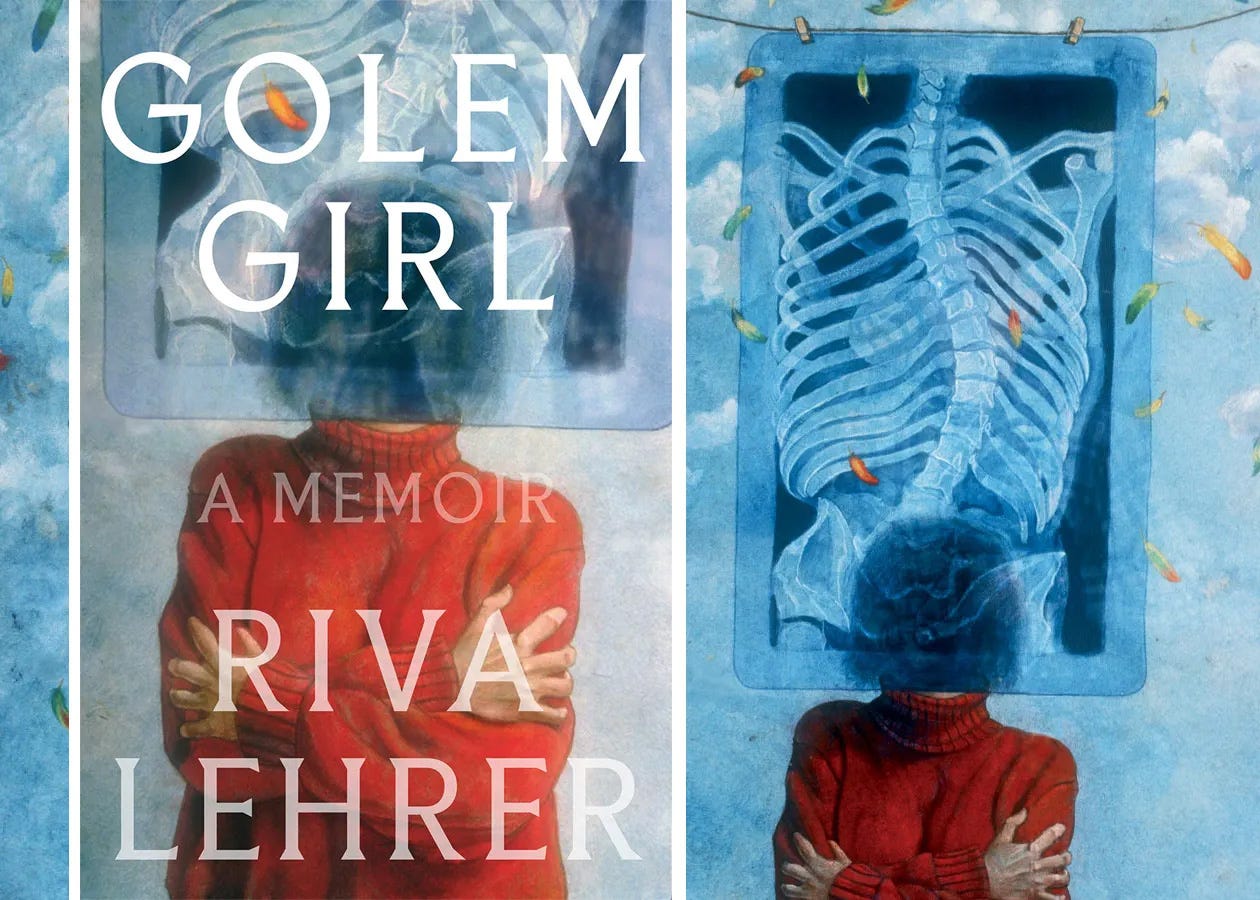
People with disabilities have long been associated with monsters. Whether it’s in folklore, literature or movies, a person’s physical deformities and limitations have become our cultural shorthand for an inner corruption of the soul.
For a long time, Riva Lehrer saw her disability as that which made her monstrous. Like Frankenstein’s creation or the Golem of her Jewish heritage, these are all monsters shaped by human hands and brought to life through an act of will.
Riva was born with spina bifida in 1958 and was one of the first babies to have received spinal surgery for what had been a nearly universally fatal birth anomaly. In her memoir, Golem Girl, she draws a direct line between the surgeons that shaped and reshaped her body and the “monster” that she saw reflected in the mirror. Still, against the odds, she survived and over her lengthy, accomplished career as an artist, educator and activist, she’s challenged the way that people with disabilities are seen in portraiture.
In my research to find the ordinary in the disabled experience represented in art, Riva’s paintings were an absolute gold mine. After months of following breadcrumbs across the Internet, I stumbled upon her work through Pinterest—of all places—and instantly found myself drawn to her portraits of disabled artists and activists. The people she represents in her work neither felt negatively charged with a mixture of pain and pity nor awash in an inspirational glow. They are simply people and I loved the way she captured their essence through their physical form and the symbols that she laces through her work.
More than that, her memoir is a very engrossing read. I’ve been an avid audiobook listener for so many years that when her massive tome of a book arrived I was worried that I wouldn’t be able to easily lift it, much less finish it. I shouldn’t have been concerned though as once I got into her humorous, lyrical prose I couldn’t put it down.
The piece of Riva’s story that gave me the most pause was how she described the way her doctors promised over and over to correct her limping gait. They would dangle in front of her the prospect of getting to throw away her chunky black orthopedic shoes in favour of high heels and flip-flops. “Go go boots?” teenage Riva asks breathlessly and her doctor laughs at her enthusiasm. “Of course!” he assures her as she is booked into another round of painful surgeries… and another… and another.
None of them work. All they ever seem to result in is long painful recoveries with summer holidays eaten away by lengthy hospital stays.
It gets me because I realize that it’s only the brittleness of my bones that likely spared me from a similar string of surgeries. I too have a twisted spine and repeated fractures of my thigh bones have left the length of my legs uneven. Still, my pediatric orthopedic surgeon chose to largely leave the deformities of my bones alone. “Let’s wait and see,” he always said. He’d straighten and rod those curved bones where I was getting repeated fractures, but others with only slight bends he left untouched. These became stronger without interference and some of those bones I’ve never broken.
Now, I know that this hasn’t been true of many folks with Osteogenesis Imperfecta (OI) of my generation. Like Riva, many were subjected to numerous surgeries to straighten bones and spines. I remember once attending a talk focusing on dental issues of folks with OI. Many of us have this underbite caused, not by our lower jaws sticking out, but by the shape of our upper jaw being slightly flatter and more pulled in. I listened with fascination and no small amount of horror as the doctor described how they’d broken and reshaped the bones of this young woman’s skull so that she’d no longer have an underbite. So that she would look more “normal”.
Medical necessity? Cosmetic desire? The line is far blurrier than you might think and Riva draws the reader’s attention to it over and over again.
I too share her love and longing for nice shoes. For me, it’s more about having to shop in the children’s department due to my size. I imagine myself in bright, stylish patterned ankle boots as opposed to the glittery nonsense available to me… Spider-Man boots… or Dora the Explorer.
I’ll jokingly tell Stefan that someday when I’ve made my millions, I’ll have my own cobbler to make me fancy shoes. I’m realizing now that this desire for custom-made shoes perfectly encapsulates the idea of the medical model versus the social model of disability.
Medical model: I need to have surgeries to correct my abnormalities to wear the “normal” people shoes that society presents to me.
Social model: I want to have shoes that are made just for me and can accommodate all the ways that I am different.
And, before someone jumps in to say that’s an unreasonable ask of a society that is all about mass production… why couldn’t we live in a world where we 3D print our shoes to our exact specifications? Shoes could be made to fit individuals again just as they were made in the days of the cobblers of old. Wouldn’t that benefit everyone?
(Just saying… someone should get on that.)
Throughout my research journey for the exhibit project, I know what I’ve been searching for is representations in art that looked like me and felt like me. I couldn’t exactly put my finger on why, but I knew that piece of my quest was an important element in my artistic journey.
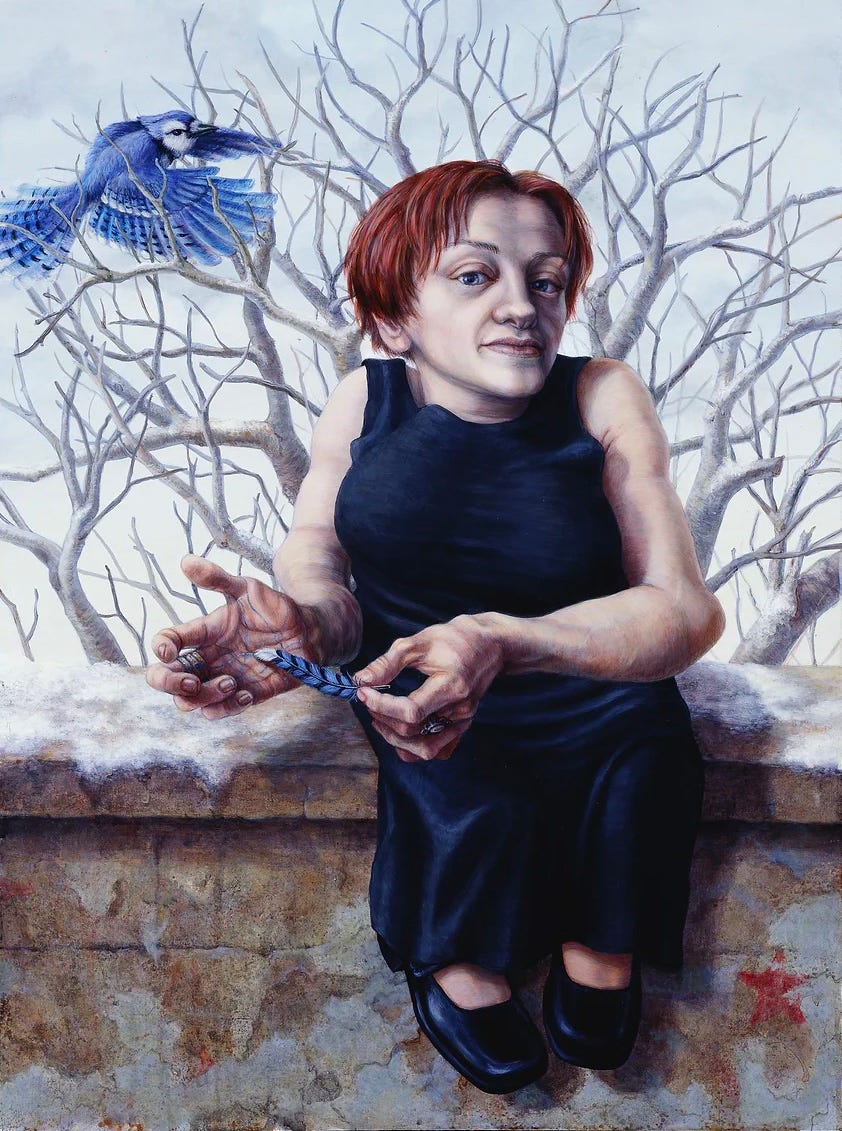
Imagine my surprise then, when I turned the page in Golem Girl and saw this painting of Rebecca Maskos looking back at me.
I suspect that because OI is a genetic disorder, folks with my condition tend to be stamped with a very distinct look about them. There’s something in the shape of the face, the pointed chin, the head sitting close to the shoulders. Even the lay of the hands which appear long and slender in relation to the person’s overall diminutive stature. There’s been more than one occasion when I’ve met a stranger on the street and our gaze will snap with recognition. We’ll both look at each other shyly for a moment, not quite daring to ask, “do you have OI?”
That’s what I felt when I saw this painting. I don’t know with 100% certainty that Rebecca has OI as Riva, quite rightfully, doesn’t casually parade about the diagnoses of the people she paints.
But that instant snap of recognition was uncanny. Here I was… or at least someone who looked just like me.
There is great comfort in knowing that, even when we are seeking to forge our artistic path, we aren’t going it alone. I know that there have been trailblazing pioneers that have gone before me like Riva Lehrer and I feel like that makes the path forward that much clearer.
I've been meaning to read this memoir for a long time, and you just convinced me to make it a priority. I think a lot about the fine line between medical and cosmetic, and I appreciate that other writers are exploring this intersection.
I am short of stature for reasons that no doctor has ever been able to figure out. My feet have always been small and I also have to shop in the kids department for my shoes. What I wouldn't give to wear adult shoes! I do save a lot of money though, ha! When I was a kid I used to fantasize about becoming best friends with a famous designer who could make all my shoes for me for free. Sadly that never happened :)
Also, I hope you feel better!